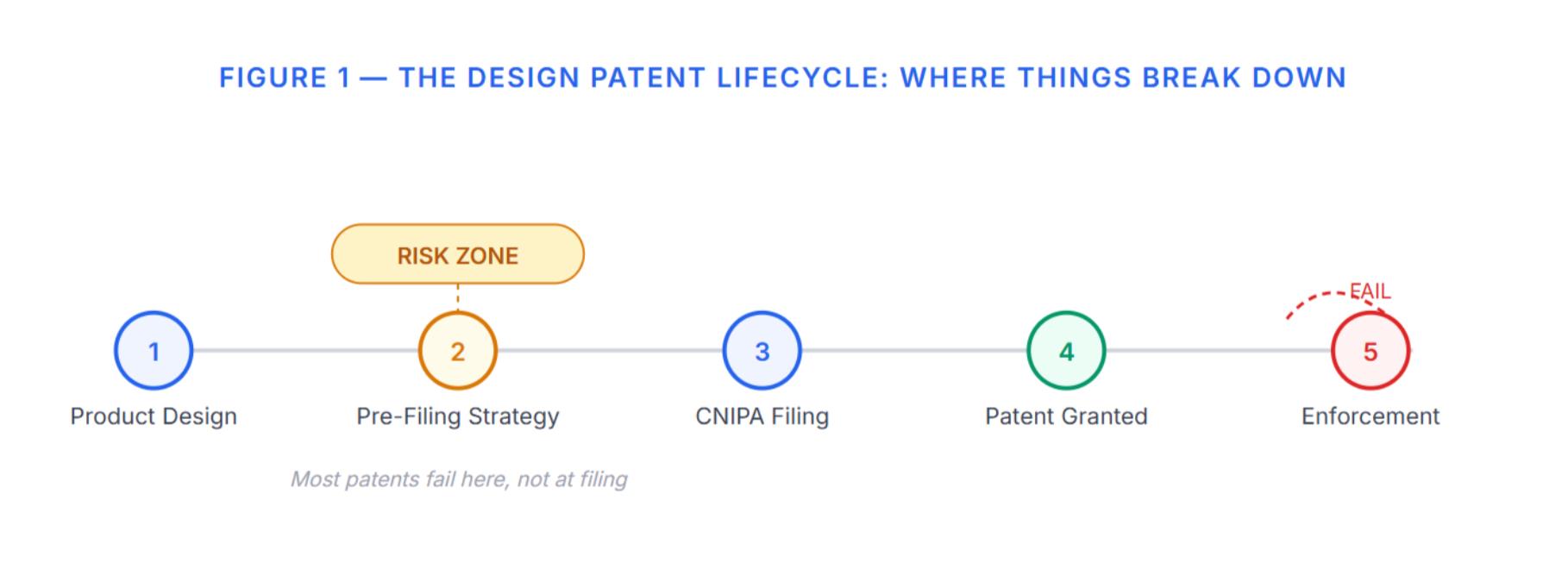
A Chinese design patent certificate looks reassuring. The official seal, the patent number, the 15-year term from filing date—it all signals protection. But in practice, a significant number of these patents turn out to be nearly worthless the moment their owners try to enforce them—whether through filing takedown complaints on Amazon, Alibaba, or AliExpress, or through litigation in Chinese courts.
The problem rarely lies with the patent office. China's CNIPA grants design patents after a formality examination that checks basic novelty and compliance. The real vulnerability is upstream:the strategic decisions made before the application is ever filed.
Based on analysis from China's leading IP practitioners and CNIPA's own patent survey data, here is what goes wrong—and what foreign companies can do differently.
The Numbers Tell the Story
China's 2024 Patent Investigation Report, published by CNIPA in January 2025, reveals a persistent gap between patent ownership and patent value. While China continues to lead the world in design patent filings—with hundreds of thousands of applications annually—the proportion of patents that survive invalidation challenges remains sobering. Industry practitioners report that in many monthly batches,the majority of challenged design patents are fully invalidated .
This is not a random phenomenon. Design patents are invalidated for predictable, avoidable reasons: insufficient novelty against prior designs publicly available on Pinterest, Behance, crowdfunding platforms, or competitor product listings; overly broad or overly narrow claim scope resulting from poor drawing strategy; and failure to account for the specific comparison methodology Chinese courts and platforms apply when evaluating infringement.
Key Statistic
In multiple CNIPA invalidation decision batches during 2025, over half of challenged design patents were fully invalidated. The most common ground: the design lacked a significant difference from prior designs that were publicly accessible before the filing date—designs the applicant should have identified during a basic pre-filing search.
Six Pre-Filing Decisions That Determine Everything
A well-prepared design patent application is the result of deliberate strategic decisions made before a single form is submitted. Based on practitioner guidance and analysis of common failure patterns, these six decisions matter most.
1. Verify Your Priority Claim Is Valid
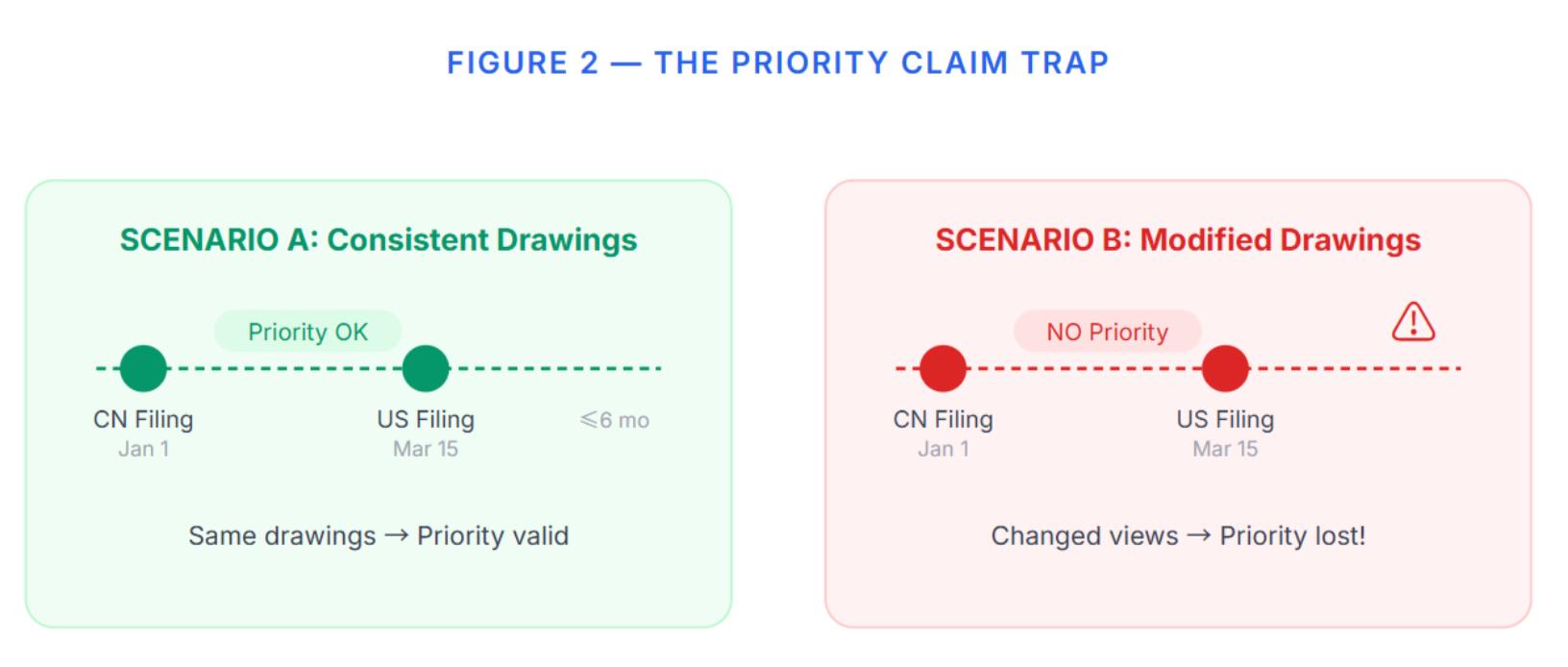
Cross-border sellers frequently file their first design patent application domestically—in China or their home country—then file subsequent applications in other jurisdictions claiming priority from the first filing.
This is standard practice under the Paris Convention, which provides a six-month priority period for design patents.
The trap is subtle but devastating: if the drawings submitted in the priority-claiming application differ materially from the original filing—different views, modified proportions, added or removed features— CNIPA may treat the priority as not effectively claimed . This means the subsequent filing's effective date reverts to its actual filing date, potentially months later, during which a competitor or a prior design published on a crowdfunding platform may have destroyed novelty.
Practical rule:The first filing is your anchor. Every subsequent application must use drawings consistent with the original filing. If your product design evolves between filing dates, consult with your patent attorney about whether the changes are material enough to jeopardize priority—before filing the second application.
2. Identify What Actually Needs Protection
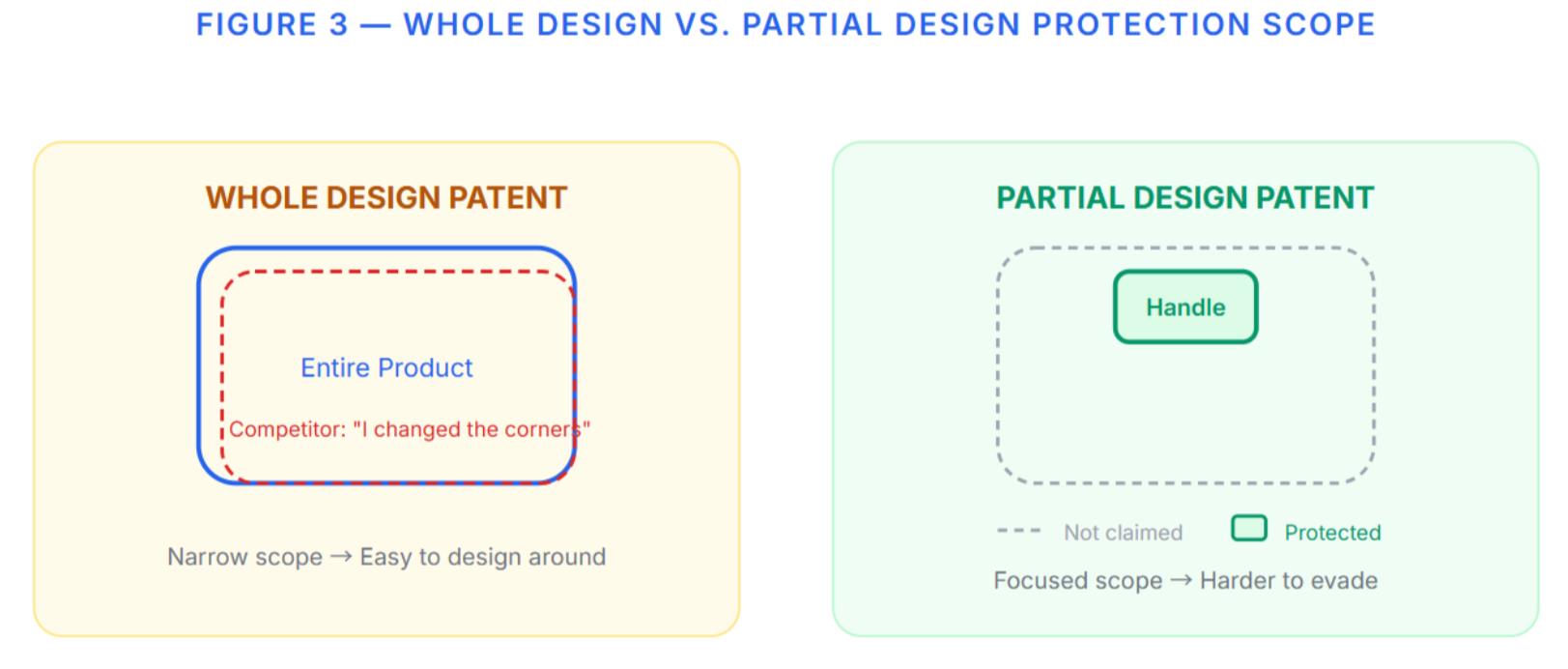
A common mistake is filing a single design patent covering the entire product, then discovering that competitors can copy the distinctive element—say, a unique handle shape or ventilation pattern—by altering everything else. The patent's scope is determined by the overall visual impression, so if the protected design is the "whole product," minor variations by competitors may fall outside the scope of infringement.
China has allowed partial design protection since June 2021, and the January 2024 amendments to the Patent Examination Guidelines clarified the specific requirements: applicants must submit drawings of the complete product with claimed portions in solid lines and unclaimed portions in dashed lines, name the specific parts being protected (not the entire product), and include a three-dimensional view for 3D designs.
Strategic Insight
Consider filing multiple applications: one for the overall design, and separate partial design patents for the most distinctive and commercially valuable elements. This layered approach significantly increases enforcement flexibility—when a competitor copies only the handle or only the button layout, you have a patent whose scope closely matches the copied feature.
3. Screen Your Own Design Sources
Before filing, professional practitioners conduct a thorough review of the design's origins: which elements are original, which were inspired by existing products on Amazon or 1688, which draw from designs published on Pinterest, Behance, or crowdfunding platforms like Kickstarter. This is not about admitting copying—it is about understanding which portions of your design are defensible and which are vulnerable.
Designs published on these platforms before your filing date constitute prior art, even if you independently created something similar. A competitor facing your infringement claim can—and will—search for any publicly accessible design that predates your filing and argue that your patent should never have been granted. If they find a close match on a crowdfunding campaign from two years before your application, the invalidation request practically writes itself.
4. Know Your Market—and Your Competitors' Designs
Sellers who operate in a product category have more market intelligence than any patent search database can provide. They know which competitor products are already on shelves, which designs are trending on e-commerce platforms, and which visual elements are becoming industry-standard rather than distinctive.
This market knowledge should inform filing strategy. If every product in your category uses a particular shape for functional reasons, patenting that shape is a waste of money—it will either be rejected for lack of distinctiveness or invalidated because the "design space" is too constrained for the feature to be considered innovative. Conversely, if you have identified a genuinely unique visual element that competitors have not adopted, that element deserves focused protection through a partial design patent.
5. Match Drawings to How Consumers Actually See the Product
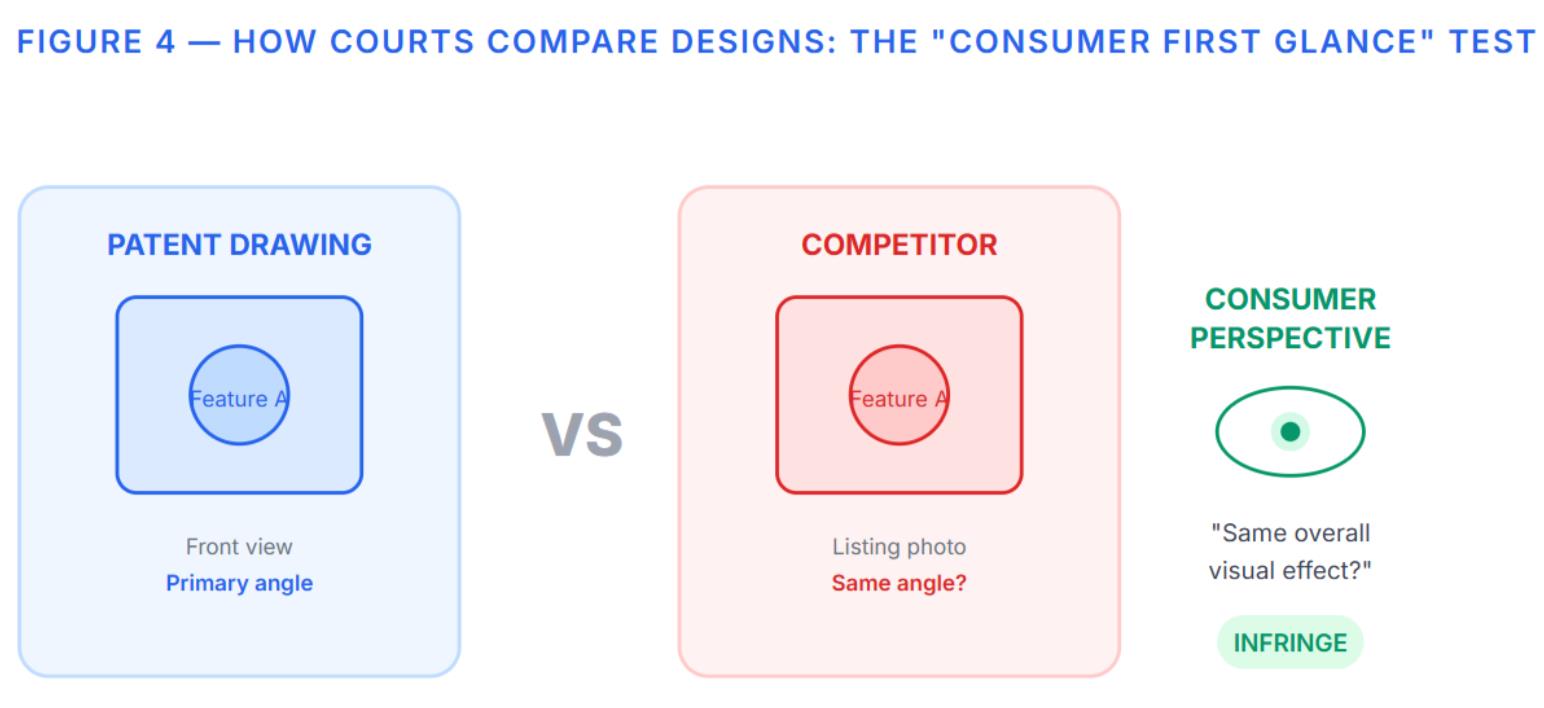
Chinese courts and e-commerce platforms evaluate design patent infringement using the "overall observation and comprehensive judgment" test, which asks: would an ordinary consumer, upon seeing the two designs, perceive them as substantially the same in overall visual effect?
This is where a surprising number of patents fail. The test is conducted from the perspective of the "ordinary consumer"—a person with average knowledge of the product type who notices differences but not minor details. Crucially,the parts of a product most easily observed during normal use carry the most weightin the comparison. Parts that are hidden, on the back, or only visible during installation receive minimal consideration.
If your patent drawings present the product from angles that do not match how the product is displayed and sold—say, the patent shows a rear view that nobody sees on an e-commerce listing page, but the front view is rendered from an unusual perspective—then a platform complaint comparing your patent against a competitor's product listing may fail simply because the visual comparison does not align.
Platform Enforcement Reality
Alibaba and AliExpress require rights holders to submit side-by-side visual comparisons when filing IP complaints. If the primary angles in your patent drawings do not correspond to the angles shown in the alleged infringer's product listings, platform reviewers may determine there is insufficient similarity—even if the products are clearly copies. Foreign design patents alone do not qualify; Chinese registration is mandatory.
6. Account for Products with Multiple Use States
For products with moving parts—foldable structures, flip covers, extendable handles, pop-up mechanisms—the static and in-use states can look completely different. If your patent only shows the folded state but the product is primarily sold and used in the unfolded state, the patent's scope may not cover the configuration that consumers actually see and that competitors copy.
The Supreme People's Court's Draft Interpretation III, released for public comment in December 2025, addresses this explicitly: when design drawings of a product in different states are inconsistent with the brief description,reference drawings of the usage state should be consideredin determining scope of protection. This means applicants need to think carefully about which states to illustrate and which to designate as the "designated drawing" representing the design.
The 2024 Rule Changes That Raised the Stakes
Foreign applicants should be aware of two significant regulatory developments that affect design patent strategy in China.
Discretionary obviousness examination.Starting January 20, 2024, CNIPA examiners gained the authority to initiate substantive obviousness examinations at their discretion for design patent applications.
Previously, design patents were granted based almost entirely on formality review and basic novelty screening. This means examiners can now reject a design patent application—not just because an identical design exists, but because the design is an obvious variation of prior art. The threshold for obtaining a design patent has effectively risen.
Expanded grace period with caveats.The fourth amendment to China's Patent Law introduced an expanded six-month grace period under Article 24, covering disclosures at international exhibitions, academic conferences, and emergency situations. The implementation regulations, effective January 2024, further broadened the definition of qualifying conferences and relaxed documentation requirements. However, practitioners uniformly advise against relying on the grace period as a strategy: "Despite these broader looking provisions, in practice, the grace period can only be applied under very specific and stringent conditions."
The Pre-Filing Checklist for Foreign Brands
Before You File a China Design Patent
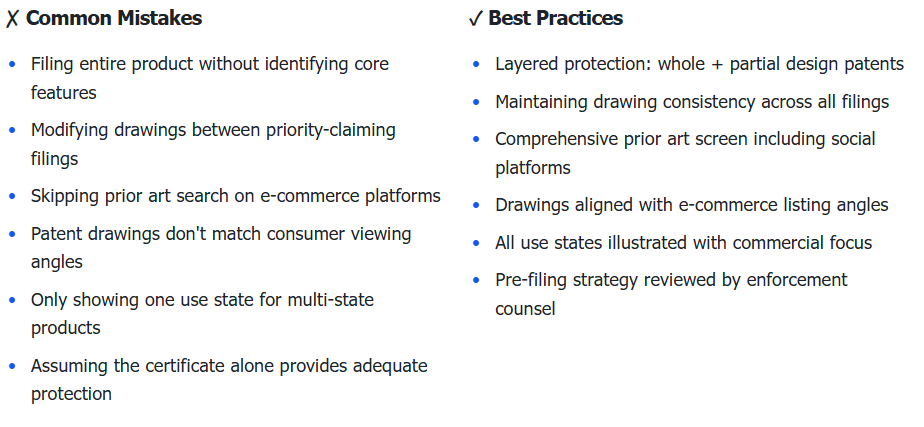
1. Audit your first filing.If claiming priority from a foreign or domestic application, confirm that drawings are consistent. Material modifications to design drawings between filings can void your priority claim.
2. Define what you are actually protecting.Don't default to filing the entire product. Identify the visually distinctive elements and consider partial design patents for maximum enforcement reach.
3. Run a real prior art search.Search not just CNIPA and WIPO databases, but also Amazon, 1688, Kickstarter, Pinterest, and Behance for any publicly disclosed designs that predate your creation. Document findings.
4. Align drawings with consumer perception.Ensure your patent's primary views correspond to the angles consumers see in actual use and in e-commerce listings. This is what platforms and courts will compare.
5. Show all relevant use states.For products with moving or transformable parts, illustrate each state that consumers will encounter. Designate the most commercially relevant state as the primary drawing.
6. Use a Chinese patent agent.Foreign applicants cannot file directly with CNIPA. Engage a registered Chinese patent attorney who understands both the formal requirements and the enforcement landscape.
The Bottom Line
China's design patent system offers genuine protection for product aesthetics—but only when the application is built on a solid strategic foundation. The certificate is not the finish line; it is the starting point for enforcement. A patent that cannot survive an invalidation challenge or cannot be effectively compared against an infringing product in a platform complaint is, in commercial terms, worthless.
For foreign brands selling into or manufacturing in China, the investment in pre-filing strategy pays disproportionate returns. A few hours of preparation—auditing priority claims, defining protection scope, screening prior art, aligning drawings with market reality—can be the difference between a patent that deters competitors and a patent that exists only on paper.
The most valuable design patents are not drawn. They are planned.

 2026-05-15
 Borsam IP
 粤公网安备 44030902003456号




 Borsam IP