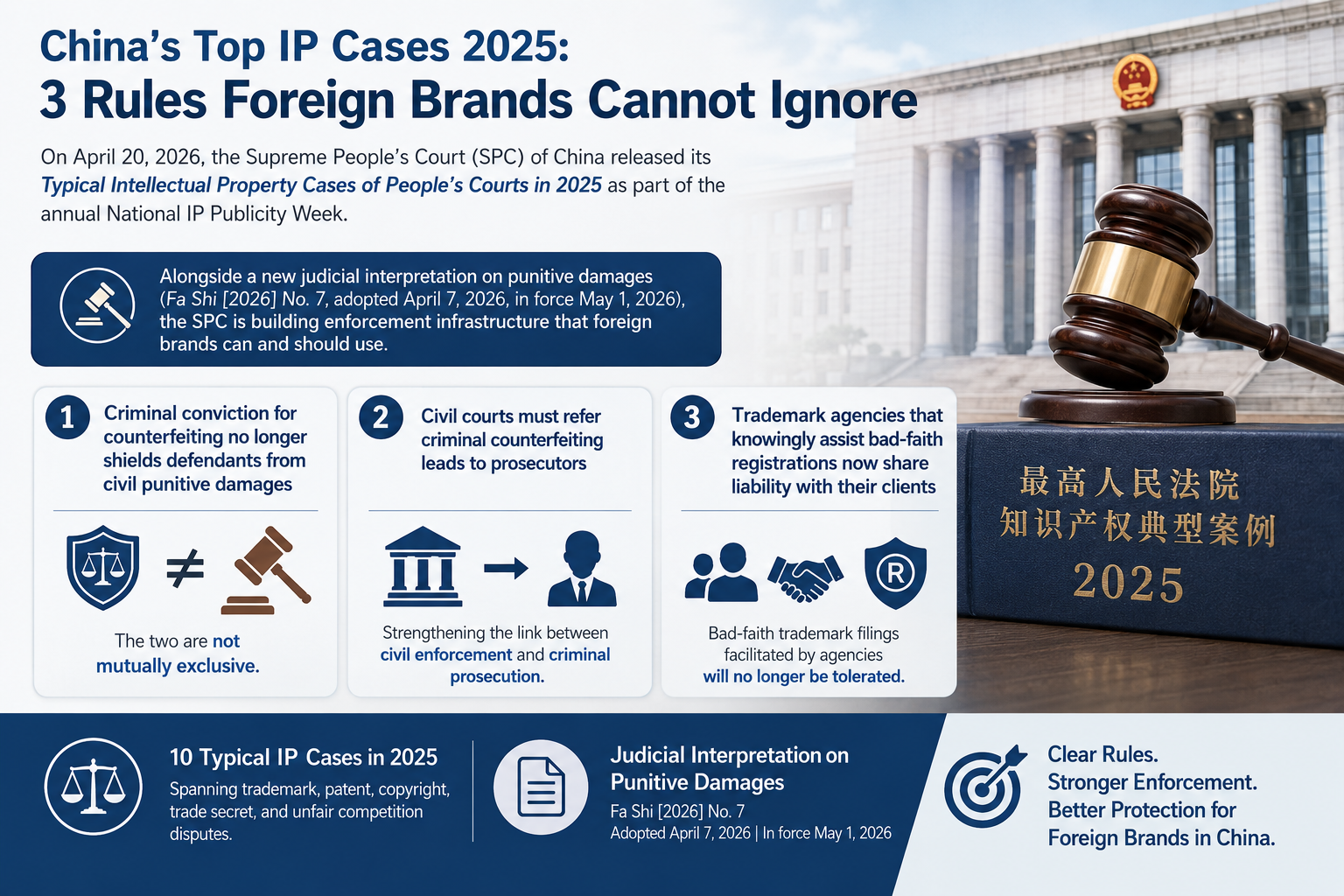
On April 20, 2026, the Supreme People's Court (SPC) of China released its Typical Intellectual Property Cases of People's Courts in 2025 as part of the annual National IP Publicity Week. Among the ten cases spanning trademark, patent, copyright, trade secret, and unfair competition disputes, three establish rules that foreign brand owners cannot afford to ignore.
Criminal conviction for counterfeiting no longer shields defendants from civil punitive damages — the two are not mutually exclusive. Civil courts must refer criminal counterfeiting leads to prosecutors. And trademark agencies that knowingly assist bad-faith registrations now share liability with their clients.
These cases were published alongside a comprehensive new judicial interpretation on punitive damages (Fa Shi [2026] No. 7, adopted April 7, 2026, and in force May 1, 2026), making clear that the SPC is building enforcement infrastructure that foreign brands can and should use.
What the three cases mean at a glance:
1. A counterfeiter can be convicted, pay criminal fines, and still face civil punitive damages.
2. Judges handling civil trademark disputes must proactively refer criminal leads to prosecutors, creating a "civil-to-criminal handoff" that closes enforcement gaps.
3. Trademark agencies that help clients register lookalike marks can be held jointly liable for the resulting damages under unfair competition law.
Case 1: 20 Million RMB in Punitive Damages After a Criminal Conviction
The most consequential case in the batch involves a networking equipment counterfeiting ring. Three individuals and their company, Beijing Zhu Co., bought used network switches at low prices, stripped them down, replaced components, changed serial numbers, repainted the casings, and slapped on authentic-looking trademark labels. They sold the refurbished units as new equipment. The trademarks at issue were registered in Class 9, covering programmable telephone switching equipment and computer network switches.
A Beijing Haidian District court had already convicted the defendants of counterfeiting registered trademarks and imposed criminal fines. The trademark owner then filed a separate civil lawsuit. This time, they named six defendants: the original four plus two more individuals who handled sales channels and funneled payments. All six were found to have made infringement their core business.
The Beijing Haidian District Court applied three-times punitive damages and ordered the six defendants to jointly pay 20 million RMB in economic damages plus 100,000 RMB in costs.
The ruling was explicit: criminal penalties and civil punitive damages address different legal interests. A criminal fine punishes the offense against public order. Civil punitive damages compensate for the private harm and deter future conduct. One does not consume the other.
The court did factor the criminal fines into its calculus. It chose three-times punitive damages rather than a higher multiplier, explicitly noting that some defendants had already paid criminal penalties. This proportionality check shows the court is not stacking punishments mechanically. But it is stacking them.
Case 2: The Court That Became a Prosecutor
The second case illustrates a procedural mechanism that is quietly transforming Chinese trademark enforcement.
Shandong Yiyuan County Court was hearing a routine trademark infringement dispute. The plaintiff, Fujian Nanping Nan Co., held trademarks for batteries. The defendant, Li, was a local seller. During the civil proceedings, Li produced purchase records showing that his counterfeit batteries came from a supplier named Deng.
The court did not just rule on the civil dispute and move on. It recognized that Deng's conduct — which spanned eight years of buying bare batteries, packaging them with counterfeit labels, and selling the finished products — potentially constituted a criminal offense. The court referred the file to the public security bureau.
The criminal investigation confirmed the scope. Deng had been running a full counterfeit battery assembly operation from 2016 to 2024. He bought blank batteries, printed counterfeit labels, sourced fake packaging, and assembled the finished counterfeit products for sale. The court characterized the conduct as "particularly serious."
Deng ultimately received a three-year suspended sentence, a 200,000 RMB fine, and an order to destroy all counterfeit goods. He had already compensated the trademark owner 400,000 RMB and obtained a letter of forgiveness, which contributed to the suspended sentence.
The mechanism is what matters. A civil dispute uncovered a criminal operation. The civil court initiated the criminal referral. That referral produced a conviction. This is not theory. It is how the system now operates.
Case 3: The Trademark Agency That Shared the Bill
The third case targets an actor that foreign brands dealing with Chinese trademark squatters know well: the professional agency that files lookalike marks.
Guangdong Jin Co., a beer distributor, spent five years — from 2017 to 2022 — filing more than ten trademark applications for names like "蓝味啤酒", "蓝魅啤酒", and "正韩蓝妹", all visually and phonetically close to the established "蓝妹" (Blue Girl) beer brand owned by Blue Beer (Guangzhou) Co. The China National Intellectual Property Administration (CNIPA) rejected or invalidated every single one. A prior court ruling had already found the applications violated the principle of good faith and disrupted trademark registration order under the Trademark Law.
But Jin Co. did not act alone. It hired Guangzhou Gu Co., a professional trademark agency in the same city as Blue Beer. The agency knew the Blue Girl brand. It knew the marks were similar. It filed them anyway.
The Guangzhou Yuexiu District Court found Jin Co. liable for unfair competition and ordered it to pay 500,000 RMB. Then came the part that matters for enforcement strategy: the court held the agency jointly liable for 100,000 RMB on the same unfair competition grounds, as a co-participant in the conduct. The Guangzhou IP Court affirmed on appeal.
The logic is straightforward. A trademark agency is not a passive conduit. It is a gatekeeper. If it opens the gate for a client it knows is abusing the registration system, it shares responsibility for what walks through. Notably, the basis for this joint liability was unfair competition law, not trademark infringement per se — a distinction that matters for how brand owners frame future demands against agencies.
Why These Cases Matter Now
The three typical cases did not arrive in a vacuum. They were published during the SPC's annual IP Publicity Week (April 20–26, 2026), alongside the 2026 Punitive Damages Interpretation (Fa Shi [2026] No. 7, in force May 1, 2026) and the SPC's 2025 IP Tribunal annual report.
The numbers from that report tell their own story. Chinese courts received 552,600 new IP cases in 2025. At the SPC's IP Tribunal level, punitive damages awards grew 29.4% in 2025 — 30 cases applied punitive damages with a combined award of approximately 1.13 billion RMB, surpassing the Tribunal's entire prior cumulative record in a single year. On the criminal side, procuratorial authorities prosecuted approximately 19,000 persons for IP crimes during the year.
The 2026 Interpretation itself tightened the rules. A plaintiff must now raise a punitive damages claim before the close of first-instance court debate. If the claim is raised for the first time on appeal, the court may attempt mediation; if mediation fails, the claim will not be supported. The Interpretation also codified specific scenarios that establish "intentional" infringement: continuing after a cease-and-desist notice, breaching a settlement agreement, using shell companies or nominee arrangements to conceal actual control, and making infringement a core business operation. For "serious circumstances," the Interpretation lists repeat infringement after prior judgment, destruction of evidence, and large-scale illegal profits.
The typical cases show how these rules play out in practice. Case 1 applied punitive damages after criminal conviction. Case 2 demonstrated the civil-criminal handoff the Interpretation contemplates. Case 3 held a gatekeeper jointly liable for enabling systemic abuse under unfair competition law.
What Foreign Brands Should Do
The three cases, read with the 2026 Interpretation, suggest four operational steps for foreign brand owners with trademark portfolios in China.
One: Do not treat a criminal conviction as the end of the road. If local authorities prosecute a counterfeiter, consider a follow-on civil suit for punitive damages. The Beijing case confirms there is no double-jeopardy barrier. Criminal fines may reduce the multiplier — the Beijing case ended at three times rather than five — but they do not eliminate civil recovery.
Two: Use civil litigation as an intelligence-gathering mechanism. The battery case shows that civil discovery can surface criminal leads. Purchase records, supplier invoices, and distribution contracts produced in civil proceedings can identify upstream manufacturers and large-scale counterfeiters that would otherwise stay hidden. Ask your Chinese litigation counsel whether documents uncovered in civil proceedings warrant a criminal referral.
Three: Add trademark agencies to your enforcement toolkit. If a known squatter repeatedly files lookalike marks through the same agency, that agency may now face joint liability under unfair competition law. The Blue Girl ruling requires the agency to have known or should have known the registration was in bad faith. Agencies in the same city or industry niche as the brand owner face a higher threshold to claim ignorance. A demand letter to the agency — pointing out the risk of joint liability under unfair competition law in light of this SPC typical case — may prove more efficient than fighting registrations one at a time at CNIPA.
Four: Lock in your punitive damages claim early. The 2026 Interpretation's procedural timing rules are strict. You cannot raise punitive damages for the first time on appeal and expect the court to rule on the merits; at that stage the court will at most attempt mediation, and if that fails, the claim is gone. When you file a trademark infringement complaint in China, the punitive damages request should be in the initial complaint and supported by whatever evidence of intent and severity you have at that stage. The quality of your initial filing determines whether punitive damages are even on the table.

 2026-05-29
 Borsam IP
 粤公网安备 44030902003456号




 Borsam IP