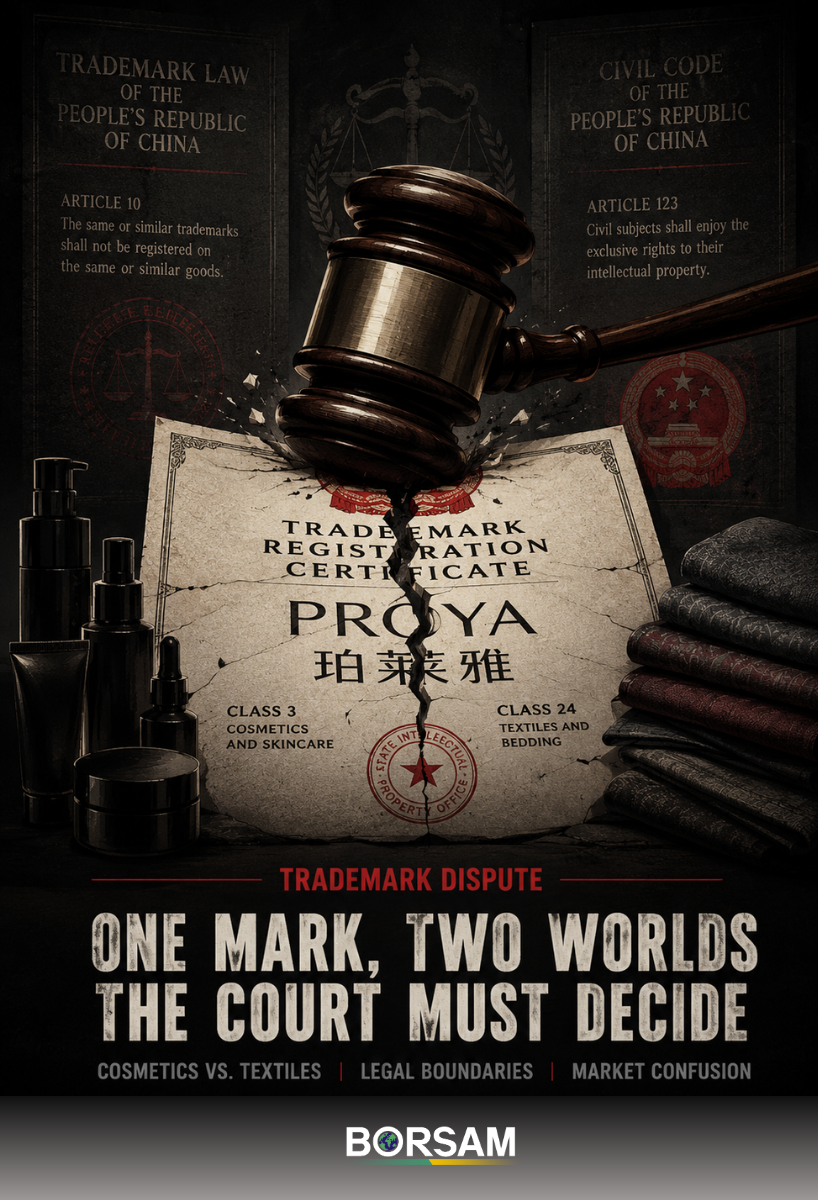
A Chinese home textiles company registered a trademark called "POLAIYA珀莱雅," then stripped out the Chinese characters "珀莱雅" and plastered them across 27 online stores selling bedding and towels. On April 28, 2026, the Zhejiang High People's Court said no. Splitting a registered trademark to free-ride on someone else's well-known mark is not legitimate use of your own registration. It is cross-class infringement under Article 13 of China's Trademark Law, and it triggers unfair competition liability under Article 6 of the Anti-Unfair Competition Law. The ruling matters for any foreign brand whose Chinese name has market recognition, because the same tactic is being used against them daily.
How a Home Textiles Company Ended Up Using a Cosmetics Giant's Name
Proya Cosmetics Co., Ltd. (珀莱雅化妆品股份有限公司) is China's largest domestically listed cosmetics company by revenue. Founded in 2003 and listed on the Shanghai Stock Exchange (SHA: 603605), it reported RMB 10.78 billion in 2024 revenue. Its core trademark, "珀莱雅" (Registration No. 3653152), registered in Class 3 for cosmetics, was recognized by the court as a well-known trademark entitled to cross-class protection.
The defendant, Shanghai Boxianzi Brand Management Co., Ltd. (珀仙子公司), held Registration No. 7325584 for "POLAIYA珀莱雅." That mark was originally filed in April 2009 by an individual surnamed Liu in Zhejiang, approved in October 2010, transferred to another individual surnamed Liu in June 2018, and finally transferred to Boxianzi in January 2024.
Boxianzi operated through a nested corporate structure. Night'an E-commerce (夜安公司) owned Boxianzi, which in turn owned Jinpolai Supply Chain (金珀莱公司). Jinpolai had been incorporated in June 2021 under the name "Polaiya (Nantong) Supply Chain Co., Ltd." (珀莱雅(南通)供应链有限公司), directly using Proya's trademark as its corporate name. It changed its name only in December 2024, after the lawsuit was filed.
What Boxianzi did with the trademark is what drew the court's scrutiny. Instead of using "POLAIYA珀莱雅" as a unified mark, it split the elements. It used "POLAIYA" separately. It used "珀莱雅" separately. It used "珀莱雅家纺" (Proya Home Textiles) separately. On e-commerce platforms including JD.com, Taobao, Douyin, Pinduoduo, and Xiaohongshu, it operated 27 online stores. It also filed dozens of new trademark applications containing "珀莱雅" across Classes 20, 24, and 27 (furniture, textiles, flooring) starting in 2023.
The Hangzhou Intermediate People's Court found infringement and unfair competition on December 30, 2025 (Case No. (2025) Zhe 01 Min Chu No. 207). The Zhejiang High Court affirmed on April 28, 2026.
Why the Court Rejected the "I Was Using My Own Registration" Defense
This is where the decision gets useful for practitioners.
The defendants' core argument was straightforward: they held a valid trademark registration for "POLAIYA珀莱雅." How could using it constitute infringement?
The Zhejiang High Court was unimpressed. It held that Boxianzi's use of "POLAIYA," "珀莱雅," and "珀莱雅家纺" constituted a splitting and reassembly of the registered trademark's constituent elements. By separating the pinyin from the Chinese characters, Boxianzi severed the intrinsic link between the two parts of the mark and changed its distinctive character.
This is the critical legal finding: using a registered trademark in a fragmented form that emphasizes another brand's well-known mark is not legitimate use of your own registration.
The court then made two further findings that foreign brands should note.
First, it held that Boxianzi had "weakened its own trademark's distinctive elements and strengthened the '珀莱雅' characters." This was not accidental. In a market where "珀莱雅" was already a well-known mark with massive consumer recognition, emphasizing those three characters while downplaying the pinyin was a deliberate strategy to attract consumers who associated "珀莱雅" with Proya.
Second, the court applied Article 13 of the Trademark Law, which provides cross-class protection for well-known trademarks. Even though Boxianzi's products (home textiles) were in different classes from Proya's (cosmetics), the well-known status of the "珀莱雅" mark meant its protection extended beyond Class 3. The court found that Boxianzi's use objectively exploited Proya's brand recognition and was "likely to cause relevant consumers to mistakenly believe that the infringing products originated from Proya or had a specific connection with Proya."
The court also found that Boxianzi's use weakened the unique correspondence between the well-known trademark and its owner. That is a dilution analysis. China's Trademark Law does not use the term "dilution" in its statutory text, but Chinese courts have been applying the concept with increasing clarity through Article 13's framework.
What This Means for Cross-Class Protection Strategy
The decision reinforces three principles that foreign brand owners should understand about China's well-known trademark regime.
Recognition is case-by-case, not permanent. China does not maintain a standing list of well-known trademarks. A mark is recognized as well-known in the context of a specific dispute, based on evidence submitted in that case. Proya had to prove its mark's fame from scratch. The court relied on Proya's revenue figures (RMB 8.905 billion in 2023, RMB 10.78 billion in 2024), its two recognitions as a Zhejiang Famous Trade Name (2012 and 2018), and its long history of continuous use since 2003.
Substance over form in assessing trademark use. The court did not stop at the fact of Boxianzi's registration. It looked at how the mark was actually used in the marketplace. A registration certificate for "POLAIYA珀莱雅" did not immunize the defendant from liability when the actual use pattern was designed to appropriate Proya's brand identity.
Corporate structure does not insulate bad-faith actors. The court treated the nested corporate structure (Night'an → Boxianzi → Jinpolai) as a single economic entity for purposes of joint liability. The five main defendants were held jointly liable for RMB 800,000 in damages and costs. Two additional parties bore proportional (joint and several) liability: one for RMB 200,000, another for RMB 50,000.
What Foreign Brands Should Do Differently Now
Three operational steps follow from this ruling.
Audit how your Chinese brand name is being used across all classes. Use the China National Intellectual Property Administration (CNIPA) trademark database to search for marks containing your Chinese brand name across all 45 Nice Classification classes. Pay particular attention to marks where your brand name is combined with other elements (pinyin, descriptive words, product category names). These are the marks most likely to be split and weaponized against you, as happened to Proya.
Document your brand's fame systematically, before you need it. Since well-known trademark recognition requires case-by-case proof, the evidence you gather today determines whether you get cross-class protection tomorrow. Revenue data, advertising spend, media coverage, consumer surveys, and prior administrative or judicial recognitions all matter. Proya's two Zhejiang Famous Trade Name certificates, issued years before the dispute, were decisive evidence. If your brand has received provincial or national recognition, preserve those records.
Monitor e-commerce platforms for split-use patterns. Boxianzi operated 27 stores across five major platforms. The splitting was visible to anyone searching for "珀莱雅" on JD.com or Taobao. Set up keyword alerts for your Chinese brand name across major Chinese e-commerce platforms. When you find a seller using your brand name alongside other characters or product categories, investigate whether they hold a registration they are splitting.
The Business Impact: RMB 800,000 and a Precedent
The damages award of RMB 800,000 (approximately USD 110,000) is modest by Chinese standards. Proya's annual revenue exceeds RMB 10 billion. The infringer's operations spanned 27 online stores and multiple offline locations. The amount suggests that Proya may not have been able to prove the full extent of the defendant's profits or its own losses.
But the precedent is the real outcome. The Zhejiang High Court has now confirmed that splitting a registered trademark to emphasize another brand's well-known mark is not legitimate use. It is infringement. And the court explicitly recognized dilution harm, not just confusion, as a basis for liability under Article 13.
For foreign brands operating in China, the message is direct. If someone registers a mark that contains your Chinese brand name, then uses it in a way that emphasizes your name while downplaying the rest, you have a viable claim. The registration itself will not protect them. The question is whether you can prove your mark is well-known and whether the defendant's use pattern shows free-riding intent. Both are factual inquiries that turn on the evidence you collect before the dispute begins.

 2026-06-05
 Borsam IP
 粤公网安备 44030902003456号




 Borsam IP