Every July, the China National Intellectual Property Administration (CNIPA) publishes its annual Top 10 Patent Reexamination and Invalidation Cases. These are not public relations exercises. CNIPA uses this list to telegraph where examination standards are heading.
The 2026 edition, published July 2, is the most diverse selection in years: four pharmaceutical cases, two involving artificial intelligence, one standard-essential patent (SEP) dispute, a design patent, an optical imaging case, and a materials science appeal. Eight are invalidation decisions, two are reexamination appeals.
Here is every case, what it decided, and the five signals foreign companies should act on.
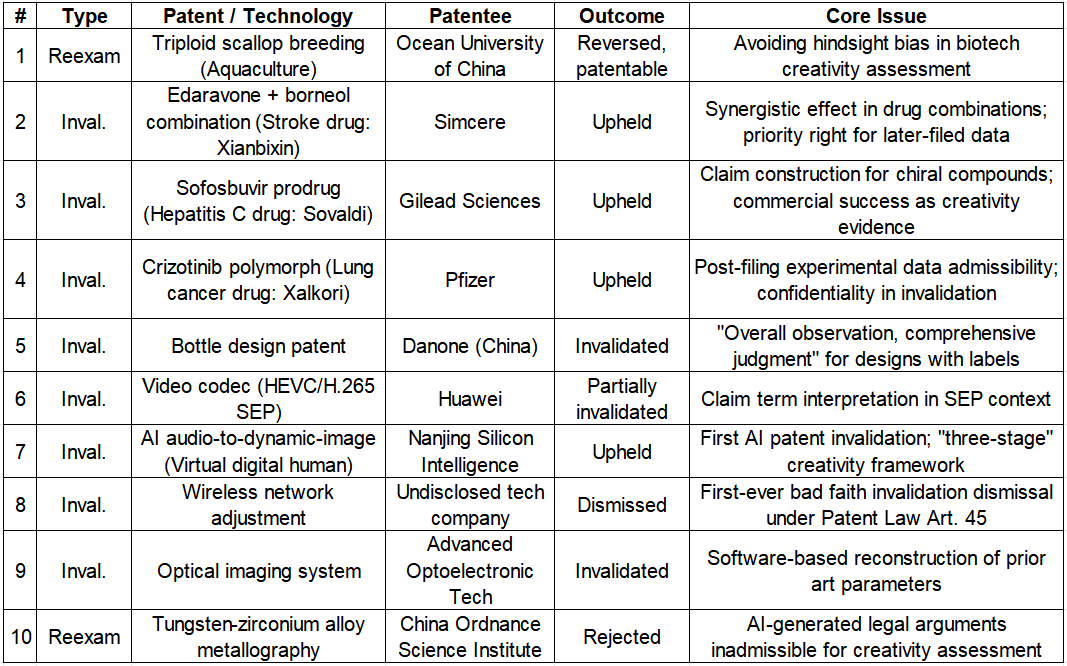
The 2026 Top 10: Every Case at a Glance
Case-by-Case Breakdown
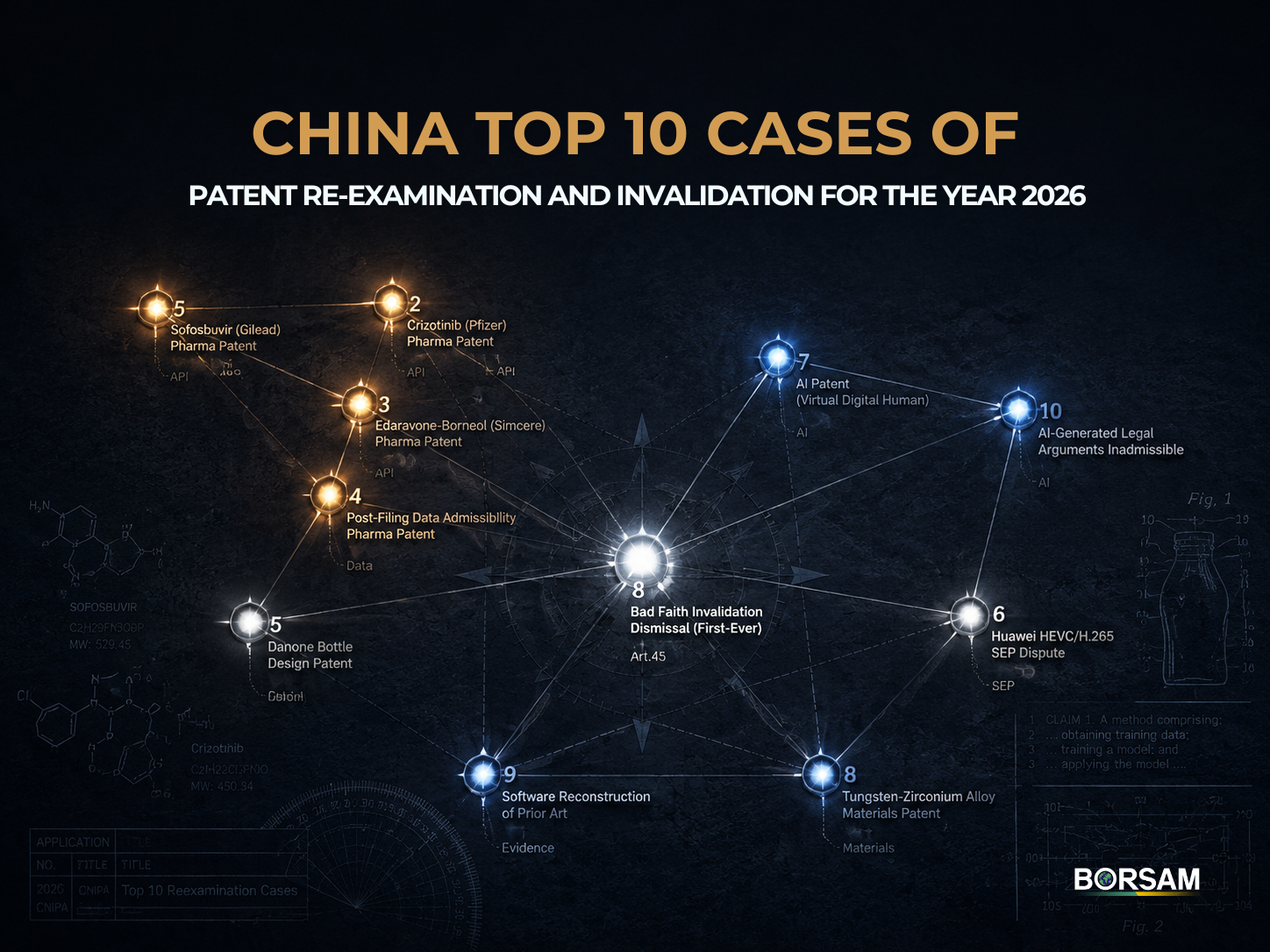
Cases 1-4: The Pharma and Biotech Block
Four cases. Three upheld patents. One clear direction: CNIPA is getting more sophisticated about pharmaceutical patent validity — and more protective of patentees who bring real science.
Case 1 (Triploid Scallops): The patent application was initially rejected for lack of creativity. CNIPA's reexamination panel reversed the examiner, ruling that using genomic screening to boost triploid yield from 12% to 100% was not an obvious routine adaptation. The key holding: examiners must assess what problem the invention actually solved, not retrofit a problem description that makes the solution seem trivial.
Case 2 (Xianbixin / Simcere): The challenger argued the combination of edaravone and borneol was obvious because both components were individually known. CNIPA rejected this argument, holding that synergy must be judged from the patent's experimental data — not retroactively dismissed through formulaic application of the Burgi or CDI formulas. Stroke is China's leading cause of death; the patent covers a domestically developed Class 1 innovative drug.
Case 3 (Sovaldi / Gilead): The most commercially significant case. Beijing Kain tried to invalidate Gilead's sofosbuvir patent, arguing the claim covered only a racemic mixture, not the S-enantiomer that became the blockbuster drug. CNIPA ruled that the wavy-line bond notation in the Markush structure covered all stereoisomers — settling a recurring dispute in Chinese pharma patent construction. The panel also accepted Gilead's commercial success argument (billions in global sales, 95% cure rate) as a secondary indicium of non-obviousness.
Case 4 (Xalkori / Pfizer): Pfizer's crizotinib crystal form patent survived a challenge from Jiangsu Wanbang. The decision is important for its treatment of post-filing experimental data: CNIPA accepted Pfizer's head-to-head comparison data (showing two orders of magnitude better Ki value than the closest prior art compound) because the experimental method was consistent with the patent's disclosure. The panel also ruled that parties cannot hide behind confidentiality claims to shield evidence from cross-examination during invalidation.
Cases 5-6: Design and SEP
Case 5 (Danone Bottle): Danone held two related patents — one for the bottle, one for the label. CNIPA invalidated the bottle patent but upheld the label. The logic: when the bottle shape is standard and the only distinctive feature is the label design, the design patent for the bottle (which includes the label) collapses. But the standalone label patent survives. This is a tightrope for consumer goods companies: design patents must be filed for the right creative element, not the whole product wrapper.
Case 6 (Huawei HEVC SEP): Amazon challenged Huawei's video codec SEP. CNIPA partially invalidated the patent, narrowing the claims. The decision's real value is methodological: it lays out how claim terms in SEPs should be interpreted — using the patent's own disclosure plus the relevant standard text, not generic dictionary definitions. For SEP holders and implementers, this is a blueprint for both prosecution drafting and invalidation strategy.
Cases 7-8: AI and Bad Faith — Two Firsts
Case 7 (AI Virtual Digital Human): The first invalidation case involving an AI patent in China. Nanjing Silicon Intelligence's patent on generating dynamic images from audio input was challenged and upheld. CNIPA articulated a "three-stage" AI creativity framework: model design, model training, model application. Examiners must pinpoint which stage the invention operates in and whether the prior art teaches the specific training methodology. Generic neural network descriptions won't cut it.
Case 8 (Bad Faith Dismissal): A Chongqing company filed an invalidation, then publicly admitted its real goal was obtaining the patent owner's contact information. CNIPA dismissed the petition with case closure notice No. 4W120605 — the first time the agency has formally rejected an invalidation request on good faith grounds under Patent Law Article 45. The panel stated bluntly: invalidation is for correcting erroneous patent grants, not for commercial harassment.
Cases 9-10: Evidence Standards in the Modern Era
Case 9 (Optical Imaging): The challenger used professional optical design software to reconstruct the prior art and prove that the patent's parameter features were already disclosed. CNIPA accepted this approach, laying out a four-factor test: legitimate software source, industry-accepted tool type, basic functions unaffected by version differences, and operation properly adapted to the prior art. The patent was fully invalidated. Software reconstruction of prior art is now a viable invalidation strategy — if done rigorously.
Case 10 (Tungsten-Zirconium Alloy): An applicant submitted AI-generated arguments in a reexamination brief, claiming the model proved a lack of technical teaching in the prior art. CNIPA rejected both the arguments and the premise: AI large language models cannot objectively reconstruct prior art or reflect what a skilled person knew at the filing date. The panel tested this by submitting identical questions to different models and got different answers. AI tools are reference material at best — they do not substitute for legal reasoning.
Five Signals Foreign Companies Must Act On
Signal 1: Bad Faith Goes Both Ways
Case 8 is the headline. CNIPA just created a new defensive tool for patent holders: the ability to get frivolous invalidation petitions dismissed at the gate. But the principle flows both ways. Patent owners who assert knowingly weak patents also face heightened scrutiny — see Case 10's implicit warning about submitting AI-hallucinated arguments. The patent system is a tool for innovation, not gamesmanship.
Signal 2: The AI Patent Playbook Is Being Written Now
Two of ten cases involve AI (Cases 7, 10). Case 7 gives you the affirmative framework: specify your training methodology, quantify your performance improvement, anchor your claims in measurable technical effects. Case 10 tells you what not to do: don't submit ChatGPT outputs as evidence. For foreign companies filing AI patents in China, the standard is crystallizing faster than in most jurisdictions. Get your specifications right now, before CNIPA raises the bar further.
Signal 3: Pharma Patents Are Surviving — With Good Data
Gilead (Case 3). Pfizer (Case 4). Simcere (Case 2). Three major pharma patents challenged, all three upheld. The common thread: each patentee brought controlled, methodologically sound experimental data. The takeaway for foreign pharma: Chinese invalidation is not a rubber stamp for generic challengers. But you need the data. Post-filing supplementary data will be considered (Case 4), provided it proves effects already disclosed in the specification. Vague descriptions of synergy without rigorous experiments will fail.
Signal 4: Claim Construction Is Getting Technical
Cases 3 and 6 tackle claim interpretation with a level of technical rigor that would be familiar to U.S. or European practitioners. CNIPA is reading Markush structures by their organic chemistry meaning, not by generic dictionary definitions. SEP claim terms are being interpreted against the standard text and the patent's own disclosure. The days of filing vague, maximalist claims and counting on examiner leniency are numbered.
Signal 5: Evidence Standards Are Being Set
Cases 4, 9, and 10 collectively map the new evidence landscape: post-filing data is admissible if it verifies disclosed effects (Case 4); software reconstruction of prior art is admissible if methodologically sound (Case 9); AI-generated arguments are not evidence (Case 10). The common denominator: CNIPA wants probative, verifiable, technically grounded evidence. No hand-waving. No AI hallucination. No confidentiality games during cross-examination.
What This Means for Your China Patent Strategy
If you hold Chinese patents: The three pharma wins (Cases 2-4) show CNIPA is serious about protecting high-value patents backed by real data. Audit your portfolio for patents where experimental evidence was thin at filing — strengthen the file wrapper now.
If you are challenging Chinese patents: Invalidation campaigns are getting harder and more expensive. Cases 8 and 10 raise the costs of frivolous filings. Cases 2 and 4 raise the bar for technical evidence. Budget for rigorous experimental counter-evidence and expect closer scrutiny of your standing.
If you are prosecuting new AI or pharma applications: These ten cases are your drafting checklist. Distinguish training methodology for AI patents. Include controlled experimental data for combination pharma patents. Claim construction will be tested against your specification — write it tight.
CNIPA handled over 8,000 invalidation requests in 2025. The 2026 top cases suggest the agency is raising the bar for everyone: patentees and challengers alike. Foreign companies that ignore these signals will find themselves fighting the last war while CNIPA has already moved on.
Need a China patent portfolio audit in light of these trends? Contact Borsam IP.

 2026-07-10
 Borsam IP
 粤公网安备 44030902003456号




 Borsam IP