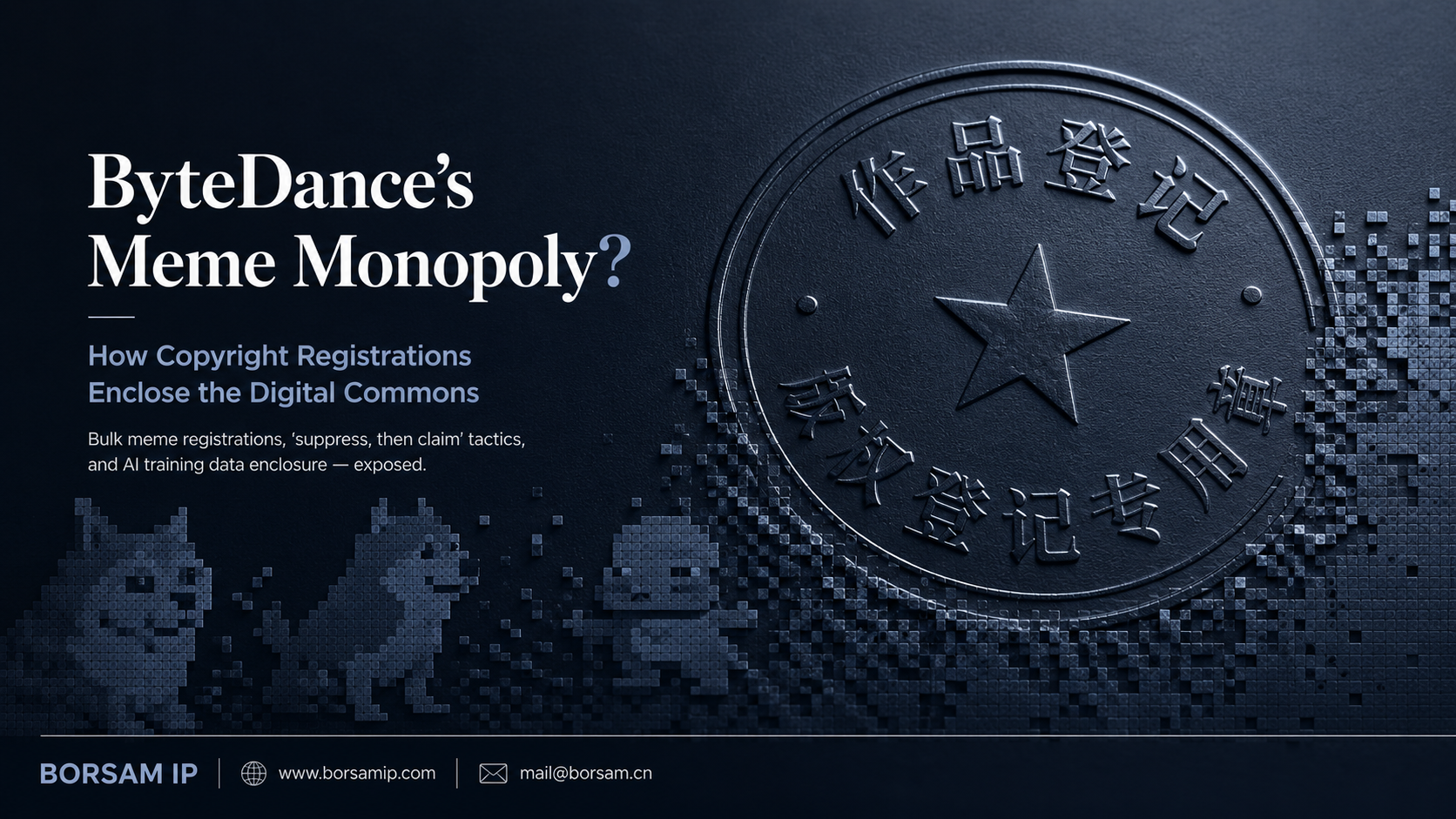
ByteDance quietly registered copyrights for dozens of the Chinese internet's most viral memes on July 2, 2026. "Gugu Gaga," "Daodun Dog," "Banana Cat," "Grass Cow" -- these were not created by ByteDance. They were built by millions of users across Bilibili, Douyin, and Weibo through years of iterative remixing. The registrations exploit a structural gap in China's copyright system, and the motive is almost certainly AI training data. Any foreign company that trains AI models on Chinese-language data or operates content platforms in China needs to be paying attention.
The Gap: Voluntary Registration, Formal Review Only
China's copyright system operates on an automatic protection principle under Article 2 of the Copyright Law (2020 Revision). Copyright exists from the moment of creation. Registration, governed by the Work Voluntary Registration Trial Measures, is optional.
Article 4 of the Trial Measures states that applicants "shall be the author, other copyright-holding citizens, legal persons, unincorporated organizations, exclusive rights holders, or their agents." But the Copyright Protection Center only checks whether forms are filled out correctly. There is no substantive examination of who actually created the work.
This means anyone can walk into the Center, submit a drawing, claim authorship, and walk out with a registration certificate. The certificate serves as "preliminary evidence" under Article 1 of the Trial Measures and Article 7 of the Supreme People's Court's Judicial Interpretation on Copyright Civil Disputes. It is rebuttable. But the burden of rebuttal falls on the actual creator, who may not even know a registration has occurred.
ByteDance's subsidiary Beijing Zijiao Network Technology Co., Ltd. submitted its own 2D and 3D renderings of these memes. The Center registered them. Procedurally, everything checks out.
The most credible explanation tracks back to February 2026. ByteDance's AI video generation model Seedance 2.0 drew cease-and-desist letters from Disney, Netflix, Sony, and Warner Bros., plus condemnation from SAG-AFTRA and the Motion Picture Association. The company had to pause Seedance 2.0's global launch.
The lesson was expensive and unambiguous: AI models trained on unlicensed content are legal liabilities. Registering copyrights for widely circulated internet memes before using them as training data is a preemptive legal maneuver. It creates a paper trail that says "we own this content."
A second layer: ByteDance has not published commercial or non-commercial usage rules for these registered works. As of July 16, 2026, the company remains silent on whether it will enforce these registrations against third-party creators. The ambiguity is the strategy.
What the Law Actually Says About Enforcement
If ByteDance uses these registration certificates to sue meme creators, commercial users, or competing platforms, it enters legally treacherous territory. The Supreme People's Court has articulated a four-element test for malicious IP litigation: (1) the lawsuit clearly lacks a rights basis or factual foundation; (2) the plaintiff knew this; (3) the defendant suffered harm; and (4) causation between the suit and the harm.
Court precedents are instructive. In (2024) E 0102 Zhi Min Chu No. 214, a plaintiff named Bi Moumei registered someone else's graphic work under her own name and sued. The court found she "knew she was not the true rights holder, lacked a rights basis, and sued to harm another's interests" -- malicious litigation.
In (2015) Shao Ke Zhi Chu Zi No. 65, a plaintiff named Xie held a valid registration certificate but could not prove actual authorship. The court found his claimed creation date postdated the work's real-world appearance, overturned the certificate's evidentiary weight, and vacated prior settlements.
The evidence against ByteDance's ownership claims is staggering. "Gugu Gaga" traces its lineage through a 2012 comedy sketch, a 2025 anime fan community, and a February 2026 Bilibili creator's AI-generated character. "Daodun Dog" is an English-language homophonic pun turned AI illustration. "Banana Cat" passed through countless anonymous iterations. The chain of prior creation is public, timestamped, and massive.
ByteDance's legal team knows this. A company with one of China's largest in-house IP departments cannot credibly claim ignorance of these memes' community origins. Notably, "Gugu Gaga" content was restricted and shadow-banned on Douyin for roughly three months before ByteDance registered the copyright. The sequence of "suppress, then claim" has not gone unnoticed by critics.
The fabrication-of-evidence risk is real. Under Articles 114 and 115 of the Civil Procedure Law, submitting falsified evidence to court carries fines, detention, and potential criminal liability. In (2023) Su 0102 Si Cheng No. 2, a court fined a plaintiff 50,000 yuan for registering someone else's photograph and using the certificate in litigation. The Supreme People's Procuratorate's 2025 IP protection typical cases included a case where defendants received prison sentences of three years, seven months, and five months for fabricating copyright registrations and filing over 90 lawsuits.
What This Means for Foreign Companies
Three implications for any company with China operations:
AI training data sourcing just became riskier. If ByteDance's registration strategy holds, expect other Chinese AI companies to follow. The Copyright Protection Center's formal-review-only system makes bulk registration of publicly available content trivially easy. A foreign company training models on Chinese-language data scraped from the open web could find itself facing copyright claims from entities that registered that data after the scraping occurred. Due diligence on training data provenance now needs to account for post-hoc registration risks in China.
Platform content moderation gets more complicated. If you operate a user-generated content platform accessible in China, your users are remixing memes that ByteDance now claims to own. The fair use provisions under Article 24 of the Copyright Law protect personal, non-commercial use -- private messages, social media posts, comment sections. But the line between personal sharing and commercial use on platforms with monetization features is blurry and untested in this specific context.
The enforcement playbook is changing. Chinese IP enforcement has traditionally favored rights holders with registration certificates. Even though the certificate is rebuttable, the practical reality is that platforms and courts give it significant weight. A foreign company receiving a takedown notice based on one of these registrations faces a non-trivial challenge: proving the registered party is not the real author requires evidence and litigation resources.
First, audit your AI training data. If your models were trained on Chinese-language internet content that includes widely circulated meme imagery, document the provenance trail. Timestamp your data collection. If you scraped content before July 2, 2026, you have a factual record that predates ByteDance's registrations.
Second, review your Chinese platform content policies. If you operate services where users can upload or remix visual content, assess your exposure to registration-based copyright claims. The Copyright Law's safe harbor provisions may offer some protection, but the evolving nature of these claims makes this an area to monitor actively.
Third, watch the enforcement signals. ByteDance has not yet taken any enforcement action based on these registrations. Whether it starts issuing takedown notices, suing commercial users, or simply sitting on the certificates as defensive assets will determine the real-world impact. The first enforcement action will be the signal.
Fourth, consider defensive registrations. If your company creates original visual content that circulates on Chinese platforms, registering your own copyrights at the Copyright Protection Center is a straightforward, low-cost protective measure. It will not prevent someone else from registering similar content, but it creates a competing evidentiary record.
This is not just about memes. It is about who controls the raw material for the next generation of AI models. China has no statutory text-and-data-mining exception for AI training. The legal status of web scraping for model training remains unsettled. Companies are improvising solutions, and registration-based rights clearance is one of them.
ByteDance's approach is aggressive and controversial, but it reflects a rational response to regulatory uncertainty. The Copyright Protection Center's formal-review-only system was designed for a pre-AI era when registration served mainly as evidence in individual authorship disputes. It was not built for bulk registration of collectively created digital culture as a training data rights strategy.
The pressure to reform this system will grow. Legal scholars have already called for the Center to exercise its authority under Article 6 of the Trial Measures to revoke registrations "found to be inconsistent with facts." Whether the Center acts is an open question. What is certain: this is the first salvo in a new kind of IP contest, and the next moves will shape the competitive landscape for AI development in China for years.
If your company is developing AI models trained on Chinese-language data or operating content platforms in China, the implications of ByteDance's copyright registration strategy deserve a closer look. Contact BORSAM's China IP practice for an assessment of your specific exposure.
Legal Disclaimer: This article is for informational purposes only and does not constitute legal advice. Copyright laws and enforcement practices vary by jurisdiction and evolve over time. Consult qualified legal counsel regarding your specific circumstances.

 2026-07-17
 Borsam IP
 粤公网安备 44030902003456号




 Borsam IP