The National Copyright Administration of China (NCAC) published draft amendments to the Implementing Regulations of the Copyright Law on July 13, 2026. The public comment period runs through August 12, 2026. This is the first comprehensive rewrite of the regulations since the 2020 Copyright Law took effect in June 2021 — and the changes reach into audiovisual works, copyright registration, enforcement, and treaty implementation. Foreign companies with content operations, distribution deals, or IP portfolios in China should pay attention now.
Why This Revision Matters
The current Implementing Regulations have been in place since 2002, with only minor amendments in 2011 and 2013. The 38-article framework was built for a pre-streaming, pre-digital-distribution China. The draft expands the regulations to 49 articles and reflects five years of accumulated gaps between the 2020 Copyright Law and its operational rules.
NCAC convened a dedicated task force for this revision, conducting surveys, expert interviews, and multiple rounds of consultation with stakeholders across industries. The draft also incorporates China's obligations under two international treaties: the Beijing Treaty on Audiovisual Performances and the Marrakesh Treaty to Facilitate Access to Published Works for Persons Who Are Blind, Visually Impaired or Otherwise Print Disabled.
The revision targets five areas:
1. Rights framework refinement: updated definitions of protected works and ownership rules
2. Authorization mechanisms and transaction rules: copyright registration, presumption of ownership, statutory licensing
3. Rights protection: five categories of public interest harm, technical protection measures, rights management information
4. International treaty implementation: accessible formats, expanded performer definition
5. Technical amendments: cross-referencing consistency across the regulatory framework
What the Draft Means for Business
Audiovisual Works Get a Technology-Neutral Definition
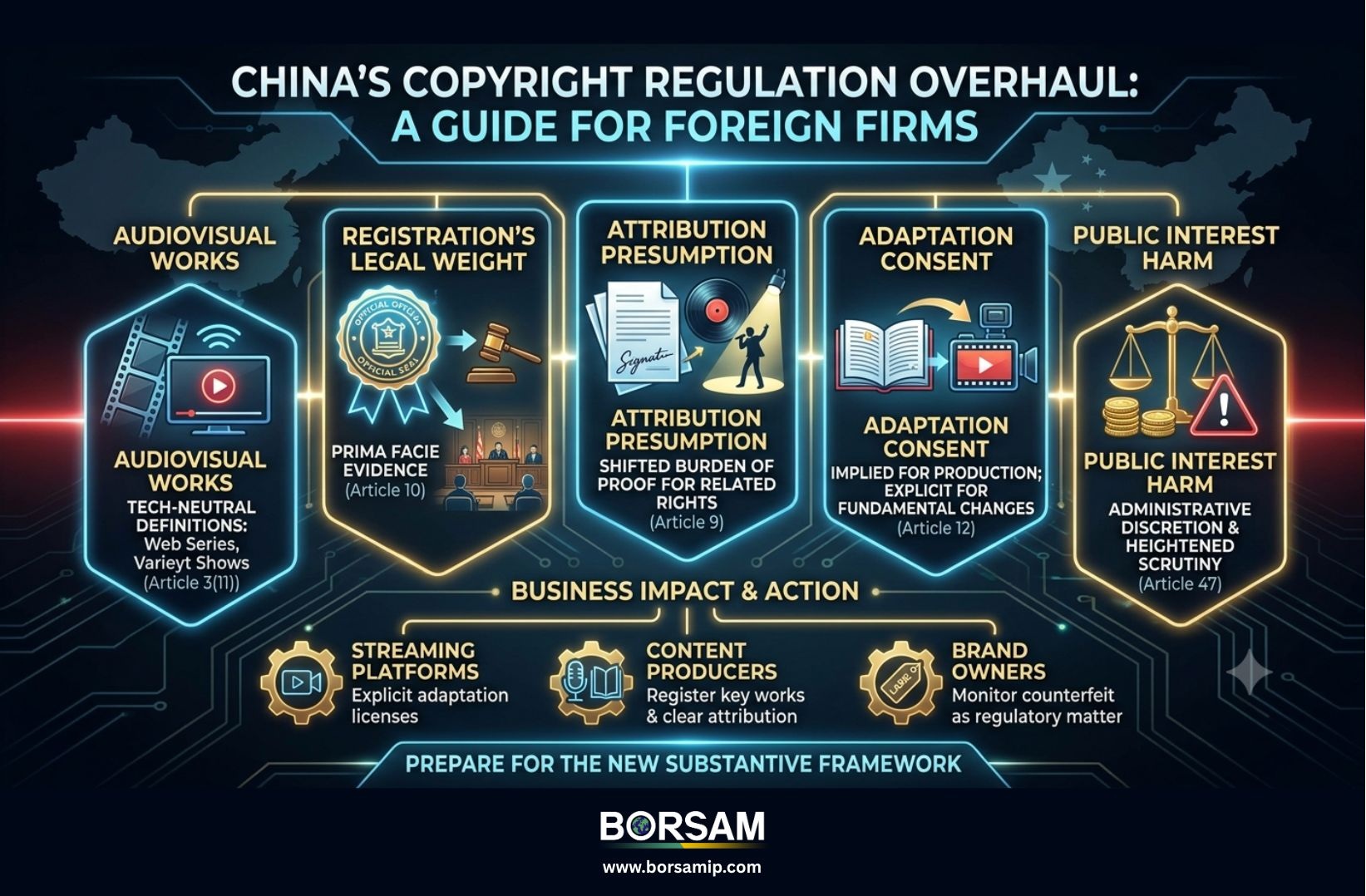
Article 3(11) of the draft replaces "cinematographic works" with "audiovisual works," a technology-neutral term. The new definition covers films, TV dramas, featurettes, documentaries, animations, web series, and variety shows. The critical change: eligibility no longer depends on the method of creation. A web series produced for a streaming platform receives the same classification as a traditional film.
This matters because the scope of protection under China's Copyright Law now tracks how content is actually produced and consumed. For streaming platforms, production companies, and anyone licensing content into China, the legal category of the work determines which rights attach and how they are enforced.
Attribution Now Creates a Presumption of Ownership for Related Rights, Too
Article 9 extends the presumption of ownership from attribution beyond authors to cover related rights holders: performers, sound recording producers, video recording producers, and broadcasters. A person or entity named on a work, performance, recording, or broadcast is presumed to be the rights holder unless evidence shows otherwise.
This is a practical enforcement tool. In infringement disputes, the burden shifts to the alleged infringer to rebut the presumption. For foreign rights holders, maintaining clear, publicly accessible attribution records becomes more important than ever.
Copyright Registration Gains Legal Weight
Article 10 is one of the most consequential provisions in the draft. For the first time, copyright registration certificates are recognized as "prima facie evidence" of the facts stated in the registration. NCAC-designated registration bodies will issue these certificates.
Until now, copyright registration in China was optional and carried limited evidentiary value in court. The draft elevates it. Foreign companies enforcing copyright in China should reassess their registration strategy. A certificate now has explicit statutory weight.
Adapting a Work into Audiovisual Format: Implied vs. Explicit Consent
Article 12 introduces a nuanced rule on adaptation rights. A license to adapt a work into an audiovisual format includes implied consent for adaptations necessary to produce the audiovisual work. However, "fundamental changes to the author's intent, thoughts, or emotions" still require explicit consent.
The practical question is where courts will draw the line between necessary adaptation and fundamental change. Content licensors and licensees should address this boundary in their agreements rather than relying on the statutory default.
Five Categories of Public Interest Harm: Discretion Replaces Fixed Penalties
Article 47 defines five specific categories of conduct that harm the public interest:
1. Harm to national image or public security
2. Harm to the socialist market economic order
3. Disruption of cultural market order
4. Profit-motivated infringement or infringement conducted as a business model
5. Other situations provided by laws and administrative regulations
The draft replaces the old fixed-fine schedule with administrative discretion calibrated to these categories. For foreign businesses, categories 2 and 4 carry particular weight. They signal that commercial-scale infringement and market-disrupting conduct face heightened scrutiny.
Technical Protection Measures and Rights Management Information
Articles 43 through 45 define technical protection measures, establish exceptions for lawful users, and exclude from protection measures that harm user data security or are unrelated to copyright protection. Article 46 defines rights management information.
These provisions implement obligations China undertook when joining the Beijing Treaty and align domestic law with international standards on digital rights management. For technology companies and content platforms, the exceptions for lawful users and the exclusion of non-copyright-related measures create boundaries that did not previously exist in regulation.
Performers and the Beijing Treaty
Article 35 provides that performers in films and TV dramas retain attribution rights and the right to protect their performances against distortion, and are entitled to contractual remuneration. This directly reflects the Beijing Treaty on Audiovisual Performances. Article 4(5) expands the definition of "performer" to include performers of folklore expressions.
For foreign producers working with Chinese performers, or foreign performers working in China, these provisions codify rights that previously existed only in treaty text, not in domestic regulation.
Where the Draft Is Silent: Artificial Intelligence
The draft contains no provisions addressing AI-generated content, AI training on copyrighted works, or liability for AI-assisted infringement. This omission is deliberate. NCAC and Chinese courts are addressing AI copyright questions through individual cases and an upcoming judicial opinion from the Supreme People's Court, rather than through regulation at this stage. Foreign companies dealing with AI and copyright in China should monitor court developments separately from this regulatory process.
For streaming platforms and OTT services, the audiovisual works definition and the adaptation consent framework in Article 12 are the provisions to watch. The technology-neutral definition reduces uncertainty about whether web-only content receives the same protection as traditional film and television. But the adaptation consent rules mean license agreements need to address the scope of permitted changes explicitly.
For content producers and publishers, the registration provisions in Article 10 and the attribution presumption in Article 9 together create a stronger incentive to register works and maintain clear attribution. These are low-cost measures that significantly improve enforcement position.
For brand owners and consumer goods companies, the public interest enforcement categories in Article 47 provide a clearer picture of when Chinese authorities will treat infringement as a regulatory matter rather than a private dispute. Commercial-scale counterfeiting operations fall squarely within categories 2 and 4.
For international law firms advising on cross-border copyright compliance in China, this draft is the most significant development since the 2020 Copyright Law. The comment period is short, just 30 days. Clients need actionable summaries now.

 2026-07-24
 Borsam IP
 粤公网安备 44030902003456号




 Borsam IP