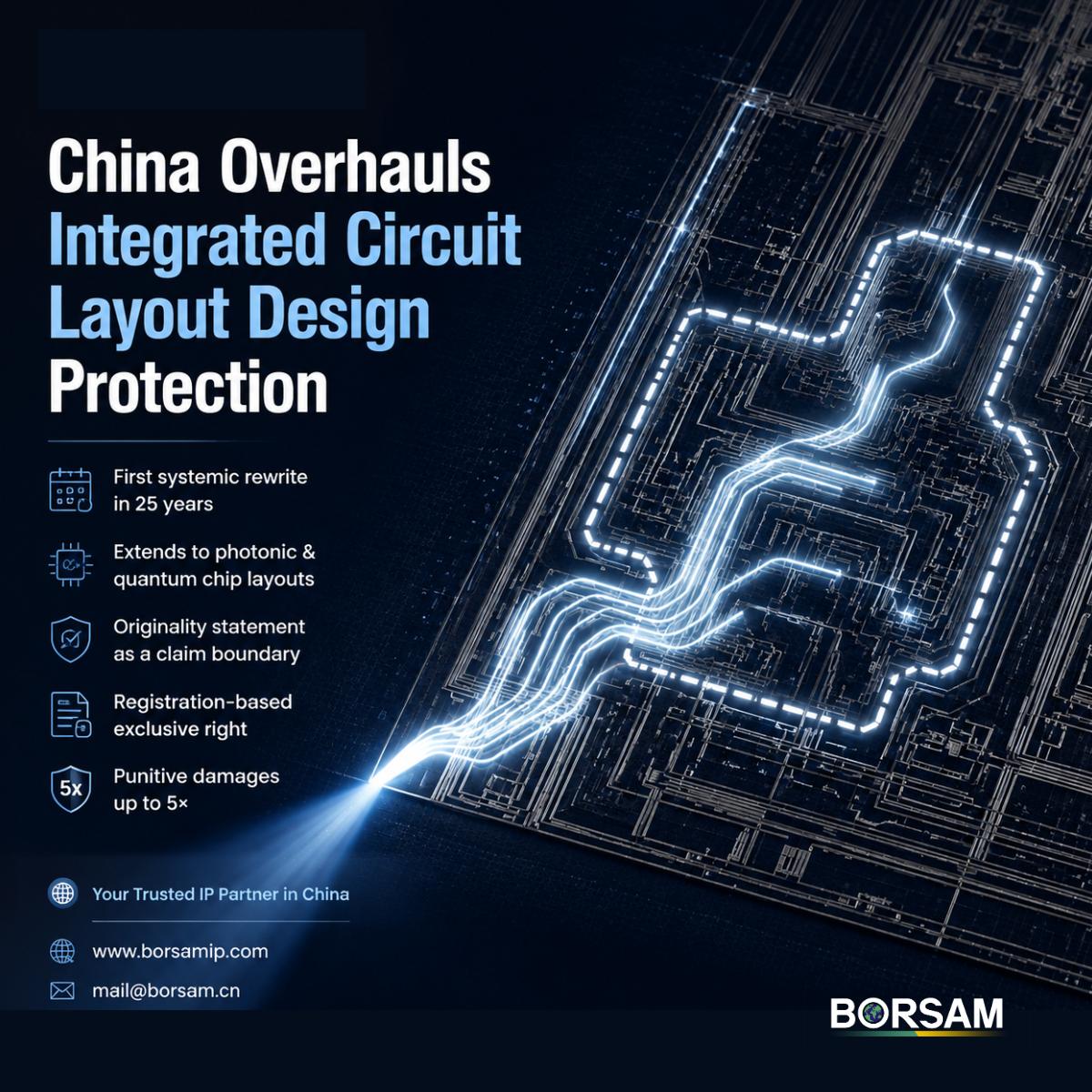
China has rewritten the law that protects integrated circuit layout designs, its first real overhaul since 2001. Protection now extends to photonic and quantum chips, requires a written originality statement to define what is protected, and lets CNIPA award punitive damages. The implementing guidelines remain open for comment until September 3, 2026, so there is a short window to influence them.
Why China is changing this now
The 2001 regulation has been untouched for a quarter century. The technology it governs has not stood still. Traditional transistor scaling is approaching its physical limits, while photonic and quantum chips are moving out of the lab and into commercial design.
Huang Yunhua, deputy director of the IP institute at the National Industrial Information Security Development Research Center, put it plainly: chip design sits upstream of the entire supply chain and decides performance, power, and competitiveness. As photonic and quantum chips shorten their product cycles, the layout architecture itself, things like waveguide routing, becomes the contested ground.
The revised regulation responds with a new provision layered onto Article 3: after the definition of "integrated circuit" — which still requires a semiconductor-material substrate — the article now adds that layout designs for chips integrating photonic or quantum functions may also be protected under the regulation. Guo He, a professor at Renmin University's School of Intellectual Property, has pointed out that the drafters did remove the older, narrower phrase "semiconductor integrated circuit" from the provisions tied to this definition, even though every monolithic chip on the market still sits on a semiconductor substrate. He reads that wording change as symbolic as much as functional: it signals, he said, that China's IP legislation is aimed at future innovation rather than past disputes, and that China is no longer a conservative actor on IP protection.
What actually changed
The most consequential change is the originality statement. Under Article 22, a registration application must now include a written statement, alongside the application form and the reproduction or drawings of the layout. Article 24 requires that statement to identify the original design areas, the design points, and their corresponding functions.
Li Shunde, a researcher at the Chinese Academy of Social Sciences Institute of Law, described this as turning an abstract originality test into a document that can be examined and used as evidence. Once filed, the statement enters the official record and becomes documentary evidence of what is, and is not, protected.
That matters because layout design protection in China is registration-based. Article 12 states that the exclusive right arises only on registration. An unregistered layout gets nothing, unlike copyright, which attaches automatically. This is the single most commonly missed point for foreign companies.
Other changes worth noting:
1. Good faith. Article 9 applies a good faith principle to both application and enforcement of the right. Abusive conduct that monopolizes a market now falls under the Anti-Monopoly Law.
2. Punitive damages. Article 46 lets damages be set at one to five times the calculated amount for willful infringement with serious consequences; the underlying amount is based on actual losses, the infringer's gains, or a reasonable multiple of the licensing fee.
3. Term. Article 17 keeps the 10-year term, running from the filing date or first commercial exploitation anywhere, whichever is earlier, with a 15-year outer limit from creation.
4. Restoration of rights. Article 33 adds a new procedure to restore rights lost to force majeure or other legitimate delay.
5. Third-party revocation. Registered layouts can now be challenged by anyone, not just CNIPA acting on its own initiative — closer to a patent invalidation-style process. A successful challenge voids the right retroactively.
The guidelines are where the details get settled
On August 3, CNIPA released two draft documents for comment: a revised set of implementing rules and a revised examination and enforcement guide, both open for comment until September 3, 2026.
The draft guide splits registration examination into an acceptance stage and a substantive review stage, with separate review tracks for obvious substantive defects and for formal application-material defects, each carrying its own notice type. It also sets out what counts as bad-faith filing — near-identical designs across multiple applications, apparent copying of existing layouts, and filing patterns with no real creative activity behind them, among other things — and tightens the standard for what counts as protectable subject matter and what qualifies as "first commercial exploitation."
For licensing, the draft confirms the three-month filing window after a license contract takes effect and, for outbound licenses, requires materials from the commerce authorities. Electronic filing is being pushed across the board. The administrative adjudication section renames several terms to match recent legal and institutional changes — "other organizations" becomes "unincorporated organizations," "administrative enforcement" becomes "administrative adjudication" — and contemplates online oral hearings and letting the parties agree on a qualified expert to determine fees.
A caveat worth flagging: some more granular procedural claims that circulate around this revision — for instance, that an originality statement can only be narrowed and never expanded once a revocation proceeding starts, or that examiners who worked on the original application must recuse themselves from a later revocation review — could not be confirmed against the publicly available text of the draft guidelines at the time of writing. Companies relying on these specific procedural points should verify them directly against CNIPA's published draft before acting on them.
What foreign chip companies should do now
Foreign owners qualify for protection under Article 4 if they first commercially exploit the layout in China, or if their home country has a protection agreement or shares an international treaty with China. Anyone without a residence or business office in China must file through a registered patent agency, per Article 5.
The two-year rule deserves your attention before anything else. Article 26 bars registration if more than two years have passed since the layout was first commercially exploited anywhere. If you have a design already in the market and never registered it in China, check the calendar before the October 15 effective date.
Concretely, I would do five things:
1. Comment on the draft implementing rules and guidelines before September 3 if the examination or adjudication rules touch your products.
2. Audit every layout design your company has put into the Chinese market and confirm registration status.
3. Revisit your originality statements. They now function as claims, and the quality of the drafting sets the width of your protection.
4. Update license and pledge templates for the new three-month filing rule and the outbound licensing materials.
5. Have photonic and quantum teams assess whether their layouts now fall inside, or infringe, the expanded scope.
The commercial stakes
Semiconductors are the arena where China's industrial policy and IP enforcement now visibly intersect. For a fabless company, the layout design is the asset. For an IDM, it is part of the crown jewels. The combination of punitive damages, administrative confiscation and destruction powers under Article 45, and a registration system that rewards early filing changes the copying calculus.
The photonic and quantum extension is the forward-looking piece. It gives companies building those chips a new defensive tool in China, and it signals that CNIPA intends the layout design regime to keep pace with whatever the industry builds next. That cuts both ways: the same scope that protects your waveguide design can also be asserted against you.
If you sell chips into China or rely on a Chinese foundry, this revision is your trigger to redo the China IP review. The window to comment on the guidelines closes September 3. If you want help mapping these changes to your own portfolio, or you would like the follow-up analysis once CNIPA publishes the final guidelines, get in touch.

 2026-08-14
 Borsam IP
 粤公网安备 44030902003456号




 Borsam IP