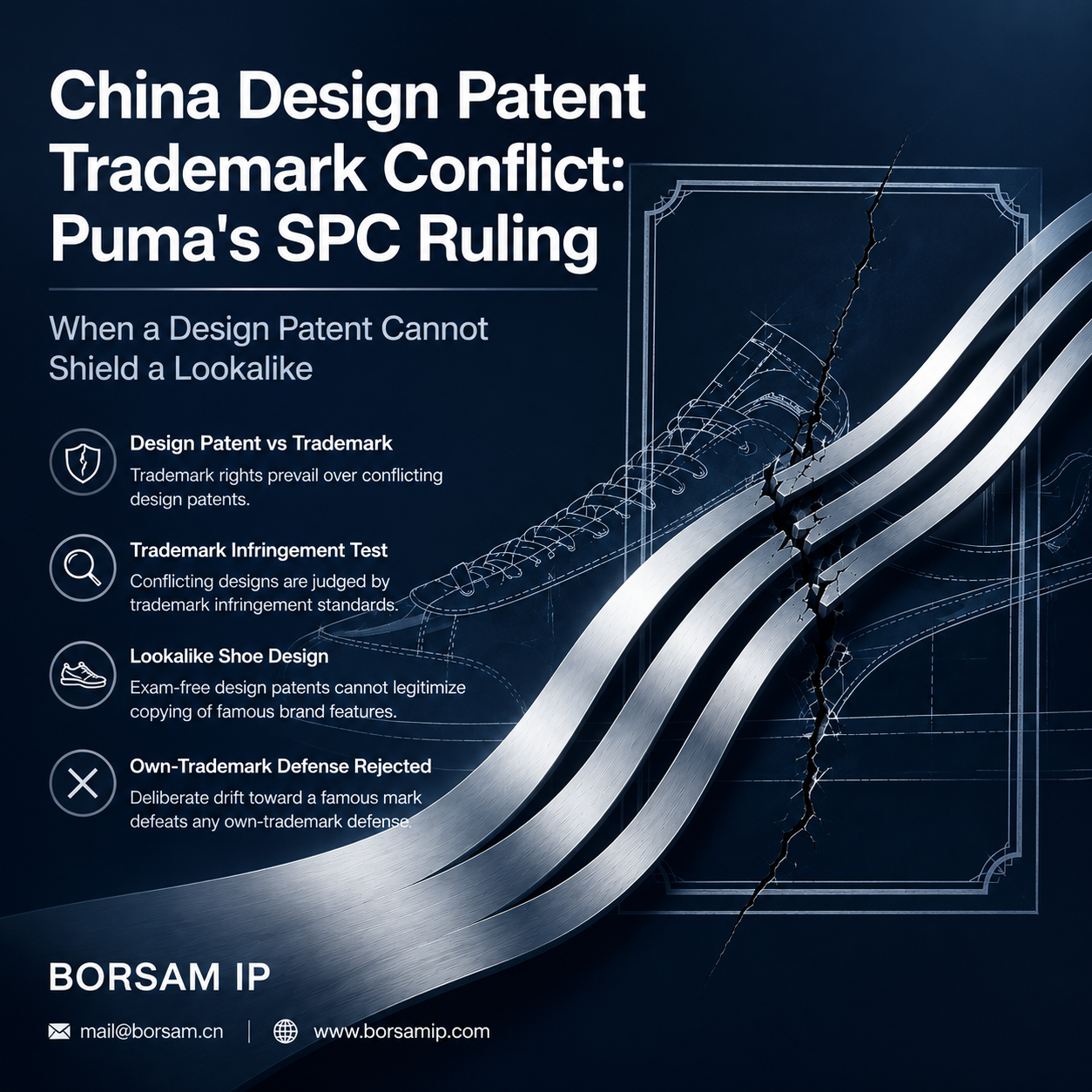
On December 26, 2025, the Supreme People's Court of China (SPC) reversed a Beijing Intellectual Property Court judgment and a China National Intellectual Property Administration (CNIPA) decision, holding that a Chinese "sports shoe" design patent conflicted with Puma SE's earlier Formstrip trademark. The Court ordered CNIPA to reconsider Puma's invalidation request against design patent No. 202230276495.6. This matters to two groups: foreign brand owners trying to stop lookalikes in China, and manufacturers or sellers who have been leaning on design patents to copy well-known brand features. Both should read it as a line in the sand.
Puma SE has used the Formstrip, its three curved stripes on the side of a shoe, since 1958. The mark has been registered in China since 1976 (Registration No. G426712), with later registrations in 1991 (No. G581191) and 2007 (No. G925647). The Court found that by the filing date of the design patent at issue, the Formstrip already carried strong distinctiveness and high recognition among Chinese consumers. The record spelled this out: Pelé wore the stripes in the 1970 World Cup final, Maradona in the 1986 World Cup, and Usain Bolt at the 2008 Beijing Olympics.
A Jiangsu company, Jiangsu Duowei Sporting Goods Co., Ltd., obtained design patent No. 202230276495.6 for a "sports shoe" in 2022. The design showed three curved stripes on the lateral side of the upper, in roughly the same position Puma's Formstrip occupies.
Puma asked CNIPA to invalidate the patent under Article 23(3) of the Patent Law, which bars granting a design patent that conflicts with another person's prior lawful rights. A Supreme People's Court judicial interpretation (Article 12) lists trademarks among those lawful rights. CNIPA refused in 2023. Its reasoning: the design looked more like Duowei's own licensed trademark (No. 612) than like Puma's stripes, and there was no proof consumers would be confused. In October 2024 the Beijing Intellectual Property Court agreed and dismissed Puma's suit. Puma appealed.
The SPC reversed in December 2025, vacating the first-instance judgment and CNIPA's decision, and ordered CNIPA to re-issue its invalidation decision. This is not a one-off. It sits inside a series of roughly seven related cases between Puma and two Jiangsu footwear makers, and the SPC ruled against the design patents in six of them.
One procedural point is worth holding onto. Puma pressed evidence of its mark's reputation partly for the first time on appeal. Chinese courts normally will not admit new evidence in patent authorization and confirmation cases, but the SPC made an exception here. It reasoned that evidence of an earlier trademark's distinctiveness and fame goes to how the relevant public perceives the design, which is exactly the kind of evidence the court must examine. Reputation evidence, in other words, is not optional garnish in these cases. It is the load-bearing fact.
The reason this matters beyond Puma is structural. China grants design patents without substantive examination. That made them a cheap, well-known workaround for copying protected brand elements: file a design patent for a lookalike, point to your own registration, and claim you are not infringing. The SPC has now said that workaround does not hold.
What It Means for Businesses
Two holdings carry the weight.
First, the test. The SPC held that whether a design patent conflicts with an earlier trademark is, in substance, a question of whether working the design would infringe the trademark. Trademark infringement standards therefore apply, judged through the general attention of relevant consumers, not a formal side-by-side design comparison. Whether a feature counts as trademark use turns on industry practice and consumer perception. On athletic footwear, a graphic on the lateral side of the upper is a classic way to indicate origin. The disputed stripes sat exactly there, large and prominent, so they functioned as a trademark rather than decoration.
Second, the own-trademark defense. Duowei argued its stripes were legitimate use of a trademark it was licensed to use. The SPC rejected that. The Court examined Duowei's licensed mark (No. 612) against the design and found two specific deviations, both moving the design closer to Puma's Formstrip. Where the licensed mark's three lines merge into one as they extend, the design kept them separate. Where the licensed mark splits evenly between the three lines and the merged line, the design gave the three lines the larger share, so consumers fix on them. Applied in the same position and manner as Puma's mark, that was not legitimate use of Duowei's own trademark.
For a foreign brand owner, the message is plain. A competitor cannot file a design patent, tweak your signature mark, and hide behind its own registration. The Court looks through the paperwork to how the product actually reads on a shelf or a screen.
If you own famous marks used in China, audit your exposure to lookalike design patents. Track competitor design filings in your product categories and be ready to file invalidation actions under Patent Law Article 23(3). Build the evidentiary record early: registration dates, sales figures, advertising spend, and evidence of recognition, because the SPC treated reputation as central to the confusion analysis. This is not a dispute you win on a single side-by-side image.
If you manufacture in China or source from Chinese factories, review the design patents your products rely on. Where a design borrows a well-known brand's identifying feature, "we used our own trademark" will not protect you. Use your marks exactly as registered, not drifted toward a famous competitor's look, and align your trademark, design patent, and licensing strategy into one plan. A design patent is now only as strong as the design is genuinely your own.
For brand owners, this is a real enforcement gain. It lowers the cost of clearing lookalikes and removes the cheapest defense the other side used to have. Expect more invalidation filings against design patents that mimic famous marks, and in some cases a faster, cheaper route than full infringement litigation.
For manufacturers and online sellers, the risk has shifted. A design patent can now be struck down precisely when you try to rely on it, and a product launch can be stopped after the patent falls. The era of treating a Chinese design patent as an independent, exam-free asset is over.
There is a cross-border dimension too. A Chinese design patent has long been used to justify listings on global marketplaces and to resist customs seizures, not just to fight domestic infringement claims. When that patent falls, the downstream justification falls with it. Sellers who built their listing strategy on such registrations should check them now, before a brand owner's invalidation filing forces the issue.
The wider signal matters too. Chinese courts are closing the gap between design law and trademark law and judging both by how products actually look to consumers. Companies built on deliberate near-miss designs should reassess that model now, before the next ruling lands on their category.

 2026-08-20
 Borsam IP
 粤公网安备 44030902003456号




 Borsam IP